




































At a Glance
Core Requirements
Required Specs (2025)
- Low seat height 17–19″
- Transfer surface ≥ 21″ × 17″
- Two adjoining sides accessible
- Sturdy support rails included
- Leg supports when stirrups used
Documentation to Keep on File
- Manufacturer's compliance cert
- Product spec sheet with dimensions
- Purchase record per unit
- Auditors will request all three
How Many Do I Need?
- 10% per category per department
- 20% for mobility-specialty facilities
- Must be distributed across depts
- Not grouped in one area
Compliance Scope
Which Facilities Must Comply?
Enforcement is split across three federal frameworks depending on your facility type.
HHS · Section 504
Federally Funded Providers
Hospitals and clinics receiving Medicare or Medicaid
- Private hospitals with federal reimbursement
- Community health centers
- Any program with federal financial assistance
DOJ · Title II ADA
State & Local Gov't Facilities
Public hospitals, government-run clinics, municipal health systems
- University health systems
- County and municipal hospitals
- All new equipment acquisitions must comply
ABA Standards
VA & Federal Facilities
Veterans Affairs medical centers and federal health programs
- All VA medical centers
- TAA compliance also required
- Standards mirror ADA MDE requirements
Product Categories
What to Look for When Buying
For each MDE category: specs to verify on a product sheet, and the key question to ask your supplier.
| Equipment Type | Required Specs | Ask Your Supplier |
|---|---|---|
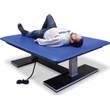
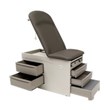
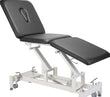
| Exam Tables | Height-adjustable to 17–19″; transfer surface min. 21″×17″; side rails; two adjacent sides accessible | Ask What is the lowest programmable height setting? |
| Exam & Treatment Chairs | Multi-position recline; full-length armrests; footrests; accessible control panel | Ask Can armrests flip for side transfers? |
| Standing Scales | Slip-resistant platform; handrails both sides full length; height 34–38″ | Ask Do handrails run the full length on both sides? |
| Bariatric & Wheelchair Scales | Platform min. 32″×40″; ramp slope max 1:8; 2″ edge protection; handrails | Ask Is the ramp compliant for self-propelled chairs? |
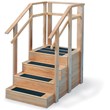
| Staircases | Continuous handrails both sides; correct tread depth; non-slip surface | Ask Does this meet current MDE tread standards? |
| Body Composition Analyzers | Controls within reach range; operable without tight grasping; bilateral handrails | Ask Can controls be used from a seated position? |
17″ vs. 17–19″ — what's current?
The U.S. Access Board updated to exactly 17″ in 2024. The DOJ and HHS still enforce 17–19″. Buying to 17″ now is the safest long-term choice.
Procurement Strategy
How to Phase In Compliance
You don't need to replace everything at once. Here's a practical sequence.
1
Start with exam tables & scales
Most frequently audited. One compliant unit per department satisfies minimum requirements immediately.
✓ Highest priority2
Calculate your minimum buy
Count units per category per department. The gap between that and your current compliant units is your minimum target.
✓ Drives budget estimate3
Distribute, don't cluster
Compliant units must be spread across departments. Plan placements before purchasing.
✓ Common audit failure4
Document as you go
Keep manufacturer certs, spec sheets, and purchase records per unit. Auditors will ask for all three.
✓ Required for accreditationCommon Questions
Frequently Asked Questions
Do I need compliant equipment even if no patient has complained?
Yes. ADA MDE compliance is a procurement obligation, not a reactive one. Waiting for a complaint is not a defensible compliance strategy.
Exactly how many compliant units do I need?
At least 10% of each equipment category per department. Mobility-specialty facilities face a 20% minimum. Units must be distributed across departments, not consolidated.
What's the exact height requirement — 17″ or 17–19″?
Currently 17–19″ under DOJ/HHS enforcement. The Access Board updated to exactly 17″ in 2024 but DOJ hasn't adopted it yet. Buying to 17″ is safest.
What documentation do I need to prove compliance?
Three things per unit: manufacturer's certification, product spec sheet confirming dimensions, and the purchase record. Keep all three on file.
Does a VA or federal facility follow different rules?
Federal facilities follow ABA standards, which closely mirror ADA MDE. VA procurement also requires TAA compliance — verify with your supplier before ordering.
Further Reading
Official Resources
ADA.gov
MDE Rule Fact Sheet
Plain-language DOJ summary. Best starting point for any procurement team.
U.S. Access Board
MDE Standards Hub
Federal guidelines, the 2024 transfer height update, and a technical helpline.
ADA National Network
Accessible Medical Equipment Guide
Practical factsheet on exam table and chair requirements.
Federal Register
DOJ Final Rule on MDE
Full text of the August 2024 rule — all technical standards and legal authority.
Tiger Medical Is Your Compliance Partner
We source and screen ADA and ABA-compliant equipment from leading manufacturers, so you can buy with confidence.
Verified compliant products
Brewer, MTI, Viva Comfort, UMF Medical & more
Reliable customer support
Browse All ADA Equipment →
Health-o-meter
-
 Current price $999.99 $999.99
 -
Current price $999.99 $999.99
-
Current price $999.99 $999.99
-
Current price $999.99 $999.99
-
Current price $999.99 $999.99
-
Current price $999.99 $999.99
-
Current price $999.99 $999.99
-
Current price $999.99 $999.99
About Health-o-meter
Health-o-meter is the number one medical scale manufacturer in the US with close to 100 years of scale production experience. Formed in 1919, Health-o-meter is the first to develop an at-home scale, the classic "doctor's" beam scale, EMR capable scales and Bluetooth Wireless Connectivity to thousands of Health-o-meter Professional Scales in the market. It is also the first medical scale manufacturer to receive an ISO-13485:2003 certification. It aims to provide customers with products with the highest-quality materials, accurate and reliable information shown, optimum comfort, ensured safety, and help increase the workflow efficiency in any medical facility.
We, at Tiger Medical, is honored to distribute the high-quality scales that Health-O-Meter is known for. A wide selection of Digital and Beam scales for professional and home use, Bariatric Scales, Wheelchair Scales, Lift Scales, Baby Scales, and Wet Diaper Scales are all available with the signature Health-O-Meter quality. If you have any questions about the products or on how to order them, please feel free to contact our friendly and knowledgeable sales representatives.