























Wall Systems
-
 Current price $999.99 $999.99
-
Current price $999.99 $999.99
-
Current price $999.99 $999.99
-
Current price $999.99 $999.99
-
Current price $999.99 $999.99
-
Current price $999.99 $999.99
-
Current price $999.99 $999.99
-
Current price $999.99 $999.99
A Buyer's Guide for Wall System Diagnostic Sets
Keep all the diagnostic instruments you need in one easy-to-reach location with an Integrated Diagnostic Wall System. With a well-designed Wall Mount Diagnostic Unit, you will never waste time again looking for your diagnostic tools because they will always stay in one place. A Wall-Mounted Diagnostic Set is always ready whenever you are.

Our Best-Seller: Welch Allyn Green 777 Integrated Wall Diagnostic System
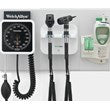
The Welch Allyn Green 777 keeps your otoscope and ophthalmoscope charged and ready on one wall unit. Choose the PanOptic LED ophthalmoscope for a 20x larger view of the eye than a standard model, and the MacroView Plus LED otoscope for 5x magnification and image capture through the iExaminer SmartBracket. The SmartBracket lets the otoscope connect wirelessly to an iPhone for image capture and data management. Optional thermometer and blood pressure add-ons complete the system.
See the Welch Allyn Diagnostic Tools in Action
How to Choose the Right Wall-Mounted Diagnostic Set for Your Practice
An integrated wall system keeps your core diagnostic instruments in one place, so staff spend less time hunting for tools between patients. Because most systems are modular, you can start with the essentials and add instruments as your budget allows.
Start with the instruments, then check the fit and the budget.
- Instruments: Look at what's included in the package. What are the field of view, image quality and ease of use of the otoscope and ophthalmoscope heads? Are they built to hold up to daily use?
- Installation: Check the mounting board, hardware and wall type, and confirm the system works with your existing setup.
- Budget: Most wall systems are modular. You can buy only what you need now and add modules, such as blood pressure or temperature, later.
What's in a Basic Diagnostic Wall System
A basic wall system includes an ophthalmoscope head, an otoscope head, a power handle and a wall-mounting board. Blood pressure monitors, thermometers and vital signs monitors are available as add-ons on some models.
| Component | Image | What It Does | What to Consider |
|---|---|---|---|
| Ophthalmoscope Heads |  |
Lets clinicians look at the back of the eye, including the retina and optic nerve. It helps in spotting signs of conditions such as glaucoma, diabetic retinopathy and retinal detachment. | Field of view, clarity of the image and ease of use. |
| Otoscope Heads |  |
Lets clinicians examine the ear canal and eardrum. It helps in identifying earwax buildup, ear infections and perforated eardrums. | Field of view, image quality and ease of use, the same as for ophthalmoscopes. |
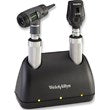
| Rechargeable Universal Power Handles |  |
Powers the instrument heads and recharges while it sits in the wall transformer, so your instruments are ready when you reach for them. | Handles are usually compatible with the ophthalmoscope and otoscope heads from the same brand. Confirm compatibility before mixing brands. |
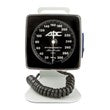
| Blood Pressure Monitoring |  |
Measures blood pressure. Wall systems typically offer an aneroid sphygmomanometer or a digital BP monitor. |
|
| Thermometers |  |
Takes a patient's temperature. Most wall systems include an electronic model that reads at the press of a button and shows the result on a large digital screen. | Speed and ease of use, since an electronic thermometer saves time between patients. |
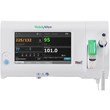
| Vital Signs Monitoring |  |
Found in more advanced wall systems. It typically measures blood pressure, pulse rate, oxygen saturation (SpO2) and temperature. Some models also measure respiration rate. | If you already own a vital signs monitor, you can often mount it on the wall system with a compatible bracket. |
| Wall-Mounting Boards |  |
Integrated systems include a pre-drilled mounting board, which makes installation simple. | Choose a spot where staff can reach the instruments easily in each exam room, and check your wall type and mounting hardware. |
Spot Check vs. Continuous Monitoring
Before building your system, decide whether you need spot checks or continuous monitoring.
- Spot checks: Staff measure vital signs at set intervals, often every 4 to 6 hours for lower-acuity patients. Wall systems are designed for this kind of check.
- Continuous monitoring: The patient's vital signs are tracked in real time, which is more common for higher-acuity patients. This calls for a dedicated monitor at the bedside, not a wall system.
Find the Right Wall System at Tiger Medical
Tiger Medical carries integrated wall systems and the instruments that go with them. Browse Otoscopes, Ophthalmoscopes, Blood Pressure, Thermometry and Spot Vital Signs Monitors, or see all Diagnostic Sets. Call 877-866-7400 or request a quote, and our team will help you build a system that fits your exam rooms.